
Stored Product Pest Experts
Serving Illinois and Indiana
Key Takeaways
- Stored product pests can contaminate products, damage packaging, and disrupt facility operations.
- These pests can enter through shipments, raw materials, packaging, and structural openings.
- Early identification and monitoring can help detect pest activity before infestations become widespread.
- Anderson uses a four-step approach focused on identification, prevention, monitoring, and suppression.
- Ongoing pest management can help protect facilities and reduce the risk of future stored product pest problems.
Stored product pests can pose a serious threat to facilities that process, manufacture, handle, or store grains, flour, dried foods, and other products. They may enter through shipments, packaging, incoming materials, doors, cracks, and other pathways before hiding in products, equipment, spills, or food debris.
An infestation can lead to product contamination, damaged packaging, production delays, failed inspections, and financial losses. Anderson Pest Solutions offers stored product pest control services throughout the Illinois area, helping businesses identify pest activity, address infestations, and establish programs designed to reduce future risks.
What Are Stored Product Pests?
Stored product pests are insects that feed on or infest stored grains, dried foods, processed food products, and other materials. Common examples include beetles, weevils, and moths. Infestations may enter a facility through contaminated shipments or raw materials, or develop when pests find food residues, spills, and suitable areas to hide.
Stored product pests can become a problem at various points throughout the supply chain, meaning even facilities with strong sanitation practices can experience an infestation. Effective control requires more than eliminating visible insects. Technicians must identify the pest species, locate areas of activity, and determine what conditions may be allowing the infestation to persist.
Common Signs of Stored Product Pest Activity
An infestation of stored product pests may go unnoticed for some time. These insects can hide inside packaging, stored commodities, equipment, and other hard-to-reach areas before adults become visible. Watch for these potential signs of stored product pest activity:
- Live beetles, weevils, moths, or other insects
- Larvae, pupae, or shed insect skins
- Silk webbing in or around stored products
- Small holes or damage to packaging
- Damaged or contaminated products
- Unusual insect activity around storage areas
- Pest activity near machinery, shelves, pallets, or other potential food sources
- Increased numbers of insects detected through monitoring devices
Finding even a small amount of activity deserves attention. Stored product insects are often difficult to detect in their early stages, and an infestation that begins in one product or area can spread to other parts of a facility if it is not addressed.
Ready for a Stored Product Pest Experts Quote?
Click the button below to leave your information and we'll be in touch with a free quote!
Where Do Stored Product Pests Come From?
Stored product pests can enter a facility in several ways. Infested raw materials, ingredients, finished products, packaging, pallets, and shipments can introduce pests without being immediately obvious. Some pests can also enter through doors, cracks, gaps, or other openings in the building.
Once inside, pests may move to other areas in search of food and suitable conditions. Food dust, product spills, residue around equipment, and overlooked material can provide additional sources of food and shelter. Research on stored product pest management has found that pest populations are often concentrated in specific areas associated with food resources and harborage rather than being evenly distributed throughout a facility.
This is why identifying the source and understanding how products and materials move through a facility are important parts of an effective pest management program.
Our Stored Product Pest Control Approach
We provide dependable stored product pest management for demanding facilities, including flour mills, food plants, and distribution centers. Our four-step process helps control pests while keeping your operations moving. Our process includes:
- Identification: Through thorough inspections and detailed monitoring, we identify pest species, locate areas of activity, and determine how pests are moving throughout your facility.
- Prevention: Our team recommends and implements structural and environmental measures designed to reduce pest entry, eliminate favorable conditions, and prevent stored product pests from becoming established.
- Monitoring: Ongoing monitoring helps us identify high-risk areas, track pest activity, and detect increases in populations before they develop into larger problems.
- Suppression: When pest activity increases, we use monitoring information to develop targeted, site-specific treatments that address the source of the problem and help bring pest populations under control.
Common Illinois Stored Product Pests
Anderson Pest Solutions provides stored product pest control for a variety of insects that can affect facilities handling grains and dried goods. Common stored product pests in Illinois include:
- Cigarette Beetle: Cigarette beetles can infest a wide range of dried foods and other stored products, including spices, flour, grains, and pet food.
- Confused Flour Beetle: Confused flour beetles commonly infest flour, grains, cereals, and other processed food products, making them a concern for food handling and storage facilities.
- Drugstore Beetle: Drugstore beetles can infest many types of dried foods and plant-based products, including flour, spices, cereals, and packaged foods.
- Indian Meal Moth: Indian meal moths are common stored product pests that can infest grains, cereals, flour, dried fruits, nuts, and other food products.
- Merchant Grain Beetle: Merchant grain beetles can infest a variety of stored grains, cereals, and processed foods, particularly products that are damaged or poorly stored.
- Red Flour Beetle: Red flour beetles commonly infest flour, grains, cereals, and other dry food products, where they can contaminate stored materials.
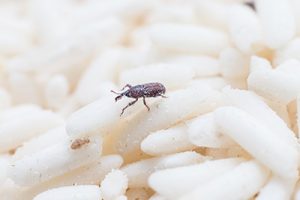
- Rice Weevil: Rice weevils primarily infest whole grains such as rice, wheat, corn, and other cereal grains, with larvae developing inside individual kernels.
- Sawtoothed Grain Beetle: Sawtoothed grain beetles can infest a variety of stored foods, including grains, cereals, flour, nuts, dried fruits, and other processed products.
Identifying the species involved is an important part of developing an effective treatment strategy. Different pests may have different food sources, behaviors, and preferred areas of a facility.
Protecting Your Facility From Stored Product Pests
Stored product pest control should not end when visible insects disappear. Pests can remain hidden in products, equipment, cracks, and other hard-to-reach areas, allowing an infestation to return or spread without being immediately detected. Sanitation is also an important part of long-term pest management, as food dust, spills, residues, and other accumulated materials can provide pests with food and harborage.
A comprehensive pest management program combines professional inspections and treatments with ongoing monitoring, sanitation, exclusion, inventory practices, and other preventive measures appropriate for your facility. Taking a proactive approach can help reduce the risk of product contamination, production delays, costly product loss, and other problems associated with stored product pests.
Professional Stored Product Pest Control in Illinois
Stored product pests can be difficult to detect and even more difficult to manage once they become established. A comprehensive pest management program can help identify activity early, address existing infestations, and reduce the conditions that allow pests to return.
Anderson Pest Solutions provides professional stored product pest control services for commercial facilities throughout Illinois. From inspection and identification to treatment, monitoring, and prevention, our experienced technicians can help you protect your facility and the products you handle.
Contact Anderson Pest Solutions today to schedule your FREE inspection.